

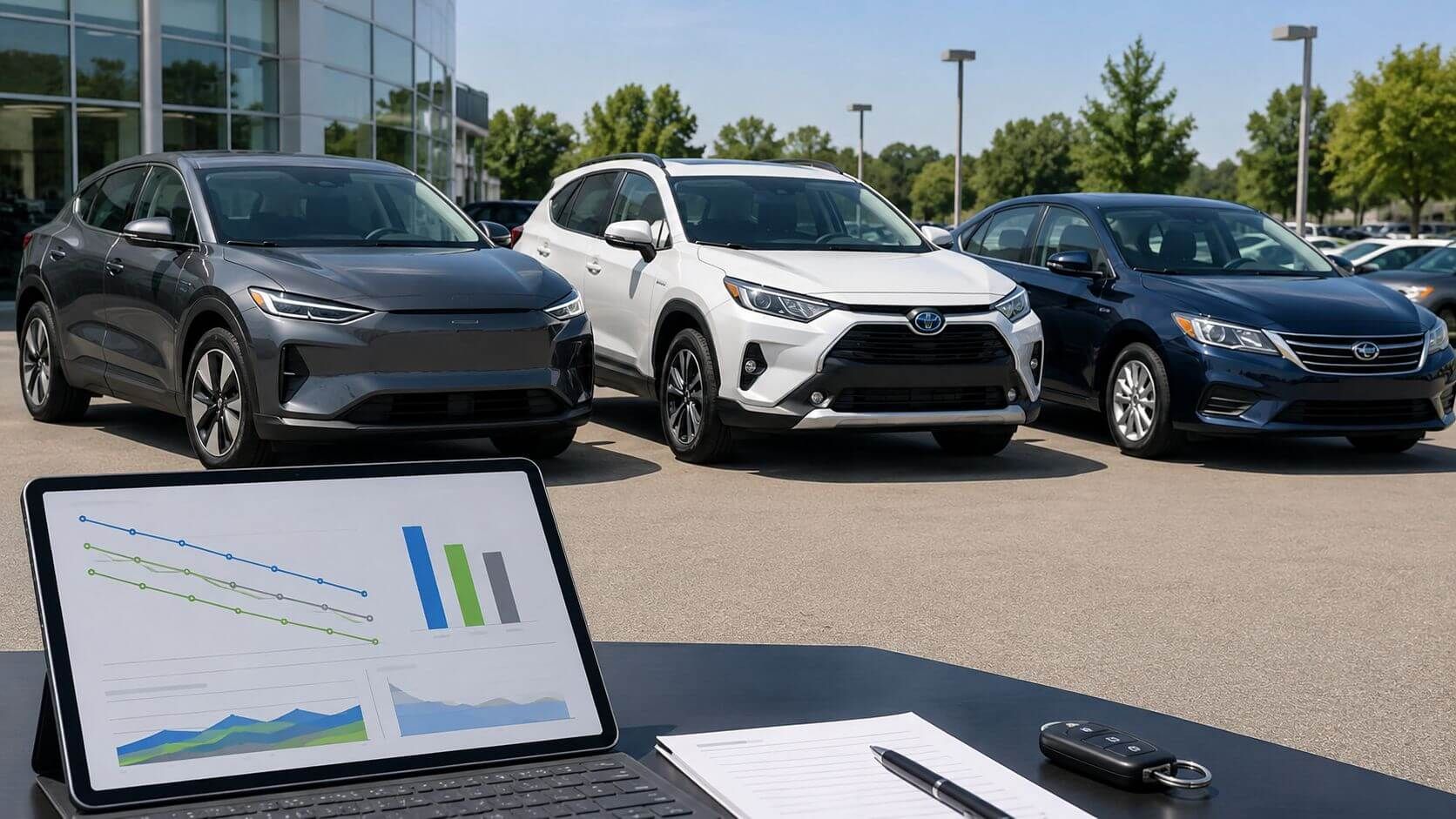
Depreciation affects every vehicle, but electric vehicles do not always lose value the same way gas and hybrid cars do.
A gas sedan, a hybrid SUV, and a used EV may all be the same age and mileage, yet their resale values can move in very different directions. For buyers, that can create opportunities. For sellers, it can create surprises. For dealers and automotive businesses, it can change pricing, trade-in, inventory, and remarketing decisions.
The reason is simple: EV value is shaped by more than age, mileage, and condition. Battery health, range, charging access, incentives, software, technology improvements, electricity costs, fuel prices, and consumer confidence all affect how the market values a used electric car.
That does not mean used EVs are bad purchases. In fact, depreciation can make them attractive to value-focused buyers. But it does mean shoppers should compare EVs, hybrids, and gas vehicles differently.
Depreciation Works Differently When the Battery Is the Main Asset
For gas vehicles, the engine and transmission are usually the major mechanical concerns. For hybrids, buyers think about both the gas powertrain and the hybrid battery. For EVs, the battery pack is one of the biggest value drivers.
A used EV buyer is likely to ask:
- How much range does the battery still deliver?
- Is the battery still under warranty?
- Has the vehicle been fast-charged often?
- Does the battery show signs of degradation?
- Is replacement likely to be expensive?
- Does the range still fit daily driving needs?
This makes EV depreciation more sensitive to perceived battery condition than gas vehicles are to ordinary engine wear. A gas car with 60,000 miles may be judged mostly by service records, condition, and reliability reputation. A used EV with the same mileage may also be judged by how much usable range remains.
That extra uncertainty can put pressure on used EV prices, especially when buyers are not sure how to evaluate battery health.
Range Matters More Than Mileage Alone
Mileage still matters for EVs, but range often matters more.
A gas vehicle with 80,000 miles can still be practical if it runs well and is maintained properly. A used EV with older battery technology may be harder to sell if its range no longer fits what buyers expect today.
For example, an older EV with a short range may be perfectly fine for local commuting. But if newer used EVs offer much longer range at a similar price, the older model may depreciate faster.
That is one reason EV values can shift quickly. The comparison set changes as newer models enter the used market with better range, faster charging, improved batteries, and newer features.
With gas vehicles, improvements from one generation to the next can matter too, but the fueling experience remains familiar. With EVs, a jump in range or charging speed can make an older model feel outdated sooner.
Charging Access Affects Resale Demand
A gas vehicle can be refueled almost anywhere. An EV depends more heavily on the owner’s charging situation.
That means used EV demand can vary based on whether buyers have:
- Home charging
- Apartment or condo charging access
- Reliable workplace charging
- Public fast chargers nearby
- Compatible charging networks
- Reasonable local electricity rates
A buyer with home charging may see a used EV as a smart, low-running-cost purchase. A buyer without reliable charging may see the same vehicle as inconvenient, even if the price is attractive.
This affects depreciation because resale value depends on the number of buyers who feel comfortable owning the vehicle. In areas where charging is convenient, used EVs may hold demand better. In areas where charging is limited, the buyer pool may be smaller.
Gas and hybrid vehicles do not face this issue to the same degree. Hybrids, in particular, can appeal to buyers who want better fuel economy without changing their refueling habits.
Incentives Can Pull EV Prices Up or Down
EV pricing can be affected by tax credits, rebates, lease deals, manufacturer discounts, and policy changes. These incentives can influence both new and used EV values.
When new EVs receive large discounts or incentives, used EV prices may fall because shoppers can compare a lightly used EV against a discounted new one. If a new EV becomes much cheaper, a used EV has to adjust.
When incentives change or expire, demand may shift again. Some buyers may rush to purchase before a deadline. Others may wait, reducing demand after the incentive period ends. That can create more volatility in used EV prices than in many gas or hybrid segments.
Gas vehicles are affected by rebates and incentives too, but EV incentives have often been more visible, more policy-driven, and more closely tied to consumer demand.
Technology Moves Faster in EVs
EVs are still a fast-developing category. Battery chemistry, charging speed, range, software, thermal management, driver-assistance features, and infotainment systems can change quickly from one model year to the next.
That fast improvement cycle can make some older EVs depreciate faster.
A used EV may lose value if newer models offer:
- Longer range
- Faster charging
- Better battery warranty
- More efficient motors
- Improved software
- Better charging network access
- More advanced safety features
- Lower new-vehicle pricing
Gas vehicles also improve over time, but many buyers understand what to expect from a gas powertrain. With EVs, buyers may compare older models more directly against the latest technology.
This can create sharper value differences between model years.
Hybrids Often Depreciate Differently Because They Feel Familiar
Hybrids occupy a middle ground. They offer better fuel economy than many gas vehicles but do not require the buyer to change how they refuel.
That familiarity can support stronger resale demand in some markets. A used hybrid may appeal to commuters, families, rideshare drivers, and budget-conscious buyers who want fuel savings without depending on charging infrastructure.
Hybrid depreciation is still affected by battery condition, mileage, reliability, fuel prices, and market demand. But the buyer hesitation is often lower than with EVs because the ownership experience feels closer to a regular gas car.
That is why some hybrids can hold value well, especially models with strong reliability reputations and high fuel economy.
Gas Vehicles Still Have the Broadest Buyer Pool
Gas vehicles remain familiar, easy to fuel, and widely understood. That broad buyer pool can help support resale demand, especially for popular trucks, SUVs, commuter cars, and reliable sedans.
Gas depreciation is usually driven by familiar factors:
- Age
- Mileage
- Condition
- Reliability
- Fuel economy
- Maintenance history
- Accident history
- Title status
- Market demand
- New vehicle pricing
- Interest rates and affordability
Gas vehicles can still depreciate quickly, especially luxury models, unpopular segments, or vehicles with poor reliability. But the market generally understands how to value them.
EVs can face more uncertainty because buyers may be pricing in unknowns around battery health, charging convenience, software support, and future technology.
Total Ownership Cost Can Change the Real Value
Depreciation is only one part of the ownership-cost story.
A used EV may depreciate faster, but it may also offer lower fuel and maintenance costs for the right owner. A hybrid may hold value well and reduce fuel spending. A gas vehicle may be cheaper upfront but cost more to fuel and maintain over time.
That is why shoppers should compare total cost, not just resale value.
Use an ownership cost by VIN estimate to compare depreciation, insurance, fuel, maintenance, repairs, taxes, and fees over time. A vehicle that loses value faster may still be a good deal if its purchase price is low enough and its running costs are manageable.
For example, a used EV with steep early depreciation may become attractive as a second car or commuter vehicle. A hybrid may have a higher purchase price but lower fuel costs and stronger resale. A gas vehicle may make sense if it is cheaper, easier to service, and better suited to long-distance driving.
The best answer depends on how you drive.
Market Value Matters Before You Buy or Sell
Because EV, hybrid, and gas values can move differently, shoppers should not rely on old assumptions. A vehicle that seemed expensive six months ago may now be more affordable. Another model may have held value better than expected.
Before buying, selling, or trading in, check the market value by VIN. A VIN-based market value estimate can help you compare similar vehicles by year, make, model, trim, mileage, and listing activity.
This is especially important for used EVs because values can move quickly when incentives, new-model prices, fleet returns, or charging-network changes affect demand.
For sellers, market value helps avoid overpricing. For buyers, it helps identify whether the asking price reflects current conditions.
Vehicle Specs Help Explain Depreciation Differences
Not all EVs depreciate the same way. Neither do all hybrids or gas vehicles.
Specifications matter.
A used EV with longer range, faster charging, heat pump technology, strong warranty coverage, and popular features may hold value better than a similar EV with shorter range and slower charging. A hybrid with excellent fuel economy and proven reliability may outperform a less efficient hybrid. A gas truck with strong towing capability may hold value better than a slow-moving sedan.
A vehicle specs by VIN lookup can help confirm the exact configuration, trim, fuel type, equipment, and vehicle attributes. That matters because small differences in trim, battery size, drivetrain, and features can create real resale differences.
Do not compare only by badge. Compare the actual vehicle.
Why Businesses Track EV, Hybrid, and Gas Values Separately
Dealers, lenders, marketplaces, insurers, and automotive platforms need to understand depreciation by powertrain because each category behaves differently.
Used EV inventory may require different pricing rules than gas inventory. Hybrids may need separate demand tracking. Gas vehicles may still dominate certain regions, price bands, or use cases. Market shifts can affect trade-in offers, loan-to-value ratios, remarketing strategies, and inventory aging.
That is where automotive market data becomes useful. Businesses can track pricing, inventory, buyer demand, days on market, and market days supply across segments. This helps teams understand whether EVs, hybrids, or gas vehicles are gaining or losing pricing strength in specific markets.
For consumers, this same idea is useful on a smaller scale: compare the type of vehicle you want against current market behavior, not last year’s assumptions.
How Buyers Should Compare EV, Hybrid, and Gas Depreciation
Before choosing a used EV, hybrid, or gas vehicle, ask:
- How much has this model typically lost from its original price?
- Is the current price fair compared with similar listings?
- Is the battery, engine, or hybrid system still under warranty?
- Does the vehicle fit my driving and charging routine?
- What are the five-year ownership costs?
- How strong is resale demand in my area?
- Are newer models making this one feel outdated?
- Does the trim or equipment improve resale value?
- Is there a history issue affecting the price?
This approach helps you move beyond simple statements like “EVs depreciate faster” or “hybrids hold value better.” Those may be true in some cases, but the actual decision depends on the exact vehicle and market.
Final Takeaway
Used EV prices depreciate differently because EVs are judged by more than age and mileage. Battery condition, range, charging access, incentives, technology changes, and consumer confidence all affect resale value.
Gas vehicles usually benefit from familiarity and broad demand. Hybrids often sit in the middle, offering fuel savings without requiring charging. EVs can depreciate faster in some cases, but that can create strong buying opportunities when the vehicle fits your lifestyle and the price reflects the market.
Before buying or selling, compare the full picture: market value, ownership cost, battery or powertrain condition, vehicle specs, warranty, and local demand.
Depreciation is not just about what a vehicle loses. It is about whether the vehicle still delivers enough value for the price you pay today.
FAQs
Do used EVs depreciate faster than gas cars?
Many used EVs have depreciated faster than comparable gas vehicles in recent years, but the pattern varies by model, battery range, incentives, demand, and local charging access. Some used EVs may become strong values after the steepest depreciation has already happened.
Why do EV prices drop differently?
EV prices are affected by battery health, range, charging access, new-model improvements, incentives, software, and consumer confidence. These factors can change faster than the traditional age-and-mileage factors used for gas vehicles.
Do hybrids hold value better than EVs?
Some hybrids hold value well because they offer fuel savings without requiring charging. However, resale value still depends on the model, mileage, condition, history, reliability, and market demand.
Is a used EV a good buy after depreciation?
It can be. A used EV may be a good buy if the range fits your needs, the battery is healthy, charging is convenient, the price is fair, and ownership costs are lower than comparable alternatives.
What should I check before buying a used EV?
Check battery health, range, warranty, charging compatibility, recall status, vehicle history, market value, ownership cost, and the exact vehicle specifications by VIN.