

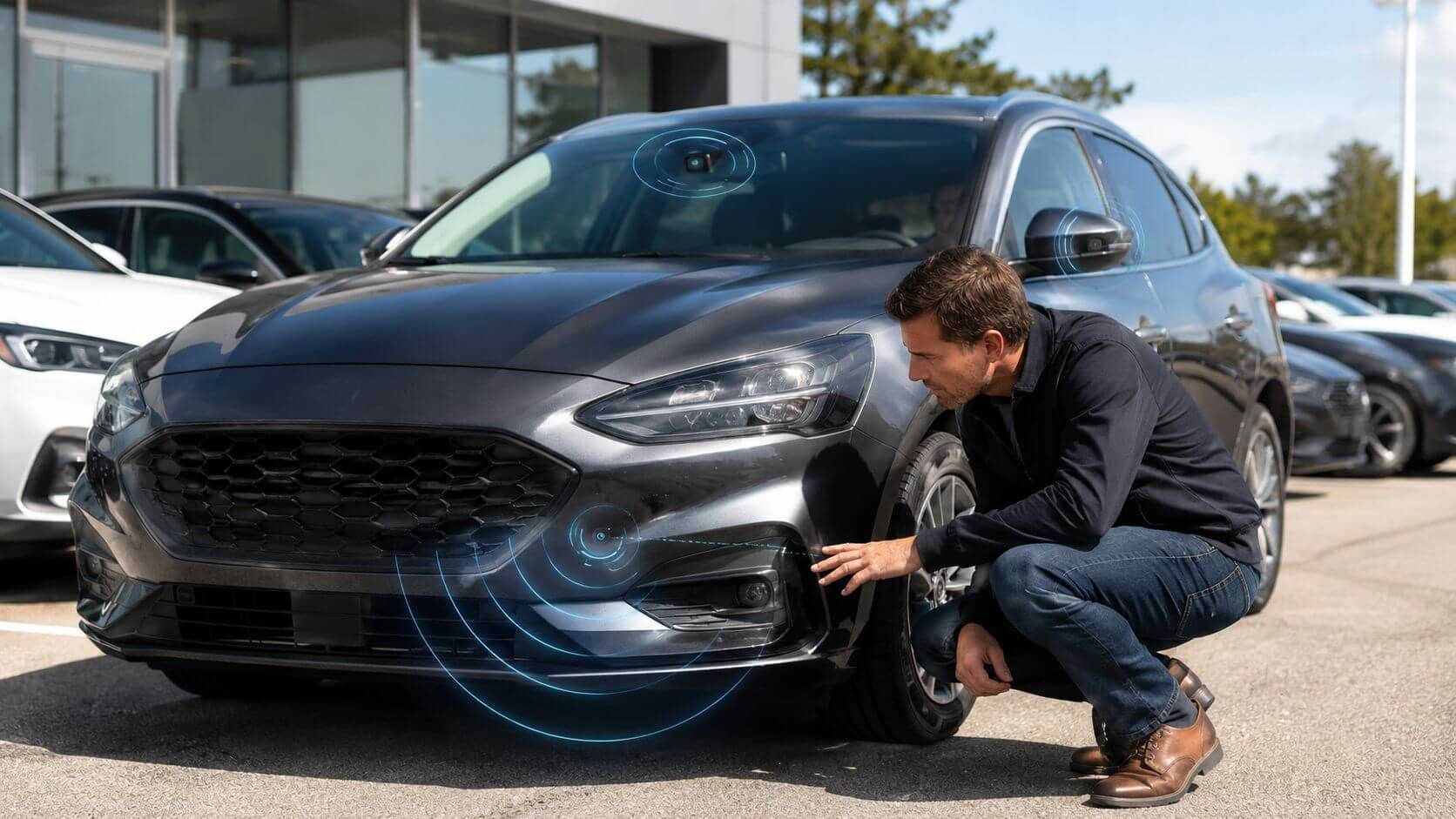
Modern used cars often come with advanced driver-assistance systems, commonly called ADAS. These features may include automatic emergency braking, blind spot warning, lane departure warning, adaptive cruise control, backup cameras, rear cross-traffic warning, parking sensors, automatic high beams, and lane keeping assistance.
For buyers, these systems can be a major selling point. They may help reduce driving stress, improve awareness, and support safer decision-making on the road. But there is one important catch: ADAS features only help when they are actually present, functioning properly, and calibrated correctly.
That matters when buying a used car. A listing may advertise safety technology that the vehicle does not have. A windshield replacement, collision repair, bumper repair, suspension work, or sensor replacement may affect how the system performs. A warning light may be ignored. An open recall may involve a safety-related system.
Before you pay extra for a used vehicle because it has “advanced safety features,” use this checklist to verify what the car has and whether those features are working as expected.
What Are ADAS Features?
ADAS stands for Advanced Driver-Assistance Systems. These are technologies designed to help drivers monitor the road, avoid hazards, reduce crash risk, or make certain driving tasks easier.
Common ADAS features include:
- Forward collision warning
- Automatic emergency braking
- Pedestrian automatic emergency braking
- Blind spot warning
- Blind spot intervention
- Lane departure warning
- Lane keeping assistance
- Lane centering assistance
- Adaptive cruise control
- Rear cross-traffic warning
- Rear automatic braking
- Backup camera
- Parking sensors
- Automatic high beams
- Traffic sign recognition
- Driver attention warning
Not every feature works the same way. Some only warn the driver. Others may apply braking or steering assistance in certain situations. Some work only at specific speeds, in clear weather, or when road markings are visible.
This is why buyers should not rely only on the feature name. You need to know what the system does, whether the vehicle actually has it, and whether it has been maintained properly.
Why ADAS Checks Matter on Used Cars
ADAS systems often rely on cameras, radar sensors, ultrasonic sensors, control modules, windshield-mounted equipment, bumper sensors, mirrors, and software.
These parts can be affected by:
- Windshield replacement
- Front bumper repair
- Rear bumper repair
- Collision repair
- Wheel alignment or suspension work
- Sensor replacement
- Mirror replacement
- Camera replacement
- Software updates
- Poor body repair
- Flood or electrical damage
A used car may look clean, but a sensor may be blocked, misaligned, damaged, disconnected, or improperly calibrated. That can create a false sense of security.
A buyer may think the vehicle has active safety support, but the feature may not work correctly when it is needed most.
Step 1: Confirm the Original Factory Equipment
Start by checking what the vehicle originally came with. Do not rely only on the seller’s description or online listing.
A window sticker by VIN can help confirm original factory equipment, trim, standard features, optional packages, MSRP, fuel economy, warranty information, and safety-related details.
This is useful because ADAS features are often tied to trim levels or option packages. One version of a vehicle may include blind spot monitoring and adaptive cruise control, while another version may not. A seller may accidentally list features from a different trim, or a marketplace may auto-fill the wrong equipment.
When reviewing the window sticker, look for safety packages or feature names such as:
- Driver assistance package
- Safety package
- Technology package
- Collision avoidance system
- Pre-collision system
- Automatic emergency braking
- Blind spot monitoring
- Lane keeping assist
- Adaptive cruise control
- Rear cross-traffic alert
- Parking assist
If the feature is not shown on the original equipment list, ask the seller to prove that the vehicle has it.
Step 2: Decode the VIN and Confirm the Trim
The VIN can help confirm the year, make, model, body style, engine, and trim details. This is important because ADAS availability may vary by model year and trim.
Before you compare safety features, decode the VIN and make sure the vehicle matches the listing.
Check:
- Year
- Make
- Model
- Trim
- Body style
- Engine
- Drivetrain
- Vehicle type
If the seller says the car is a premium trim with advanced safety features, but the VIN points to a lower trim, pause and ask questions.
Sometimes the listing is simply wrong. But if the seller is using ADAS features to justify a higher price, you should verify the equipment before negotiating.
Step 3: Identify Which ADAS Features Are Actually Present
Once you know the vehicle’s original equipment, confirm the features physically and functionally.
Look for signs of ADAS hardware:
- Camera housing near the rearview mirror
- Radar sensor in the grille or front bumper
- Parking sensors in the bumper
- Blind spot warning lights in the side mirrors
- Front-facing camera area in the windshield
- Rear camera above the license plate area
- Steering wheel buttons for adaptive cruise or lane assistance
- Dashboard menu settings for safety systems
- Warning indicators during startup
Then check the vehicle settings menu. Many ADAS features can be turned on or off. If a feature is listed in the settings, confirm whether it can be activated and whether there are any alerts.
Be careful with vague claims. “Has safety features” may simply mean backup camera and stability control. Ask for specific feature names.
Step 4: Check for Open Safety Recalls
Before buying, run a recall check by VIN. Open recalls can involve airbags, braking systems, steering systems, electrical systems, cameras, sensors, software, or other safety-related components.
You can also review recall information through the National Highway Traffic Safety Administration at NHTSA.gov/recalls.
If there is an open recall, ask:
- What system is affected?
- Is the repair available now?
- Has the vehicle already been repaired?
- Can the seller provide documentation?
- Does the recall involve ADAS, braking, steering, cameras, sensors, or software?
- Can a dealer complete the repair before purchase?
An open recall does not always mean you should reject the vehicle, but it should be resolved or clearly understood before you buy.
Step 5: Ask About Windshield, Bumper, and Collision Repairs
ADAS calibration often becomes important after repairs involving sensors or camera mounting areas.
Ask the seller directly:
- Has the windshield ever been replaced?
- Has the front bumper been repaired or replaced?
- Has the rear bumper been repaired or replaced?
- Has the vehicle been in a collision?
- Were any cameras, radar sensors, parking sensors, or mirrors replaced?
- Was any calibration performed after the repair?
- Are invoices or calibration records available?
Many buyers ask about accidents in general, but they forget to ask about repairs that can affect ADAS systems. A windshield replacement may matter because front-facing cameras are often mounted near the rearview mirror. A bumper repair may matter because radar and parking sensors may be located behind or inside bumper areas.
If the seller says repairs were done, ask for receipts showing both the repair and any required calibration.
Step 6: Inspect the Sensor Areas
You do not need to be a technician to spot obvious issues.
Walk around the vehicle and check:
- Cracked or poorly installed windshield
- Camera area blocked by tint, stickers, dirt, or damage
- Misaligned front bumper
- Loose grille pieces
- Damaged parking sensors
- Painted-over sensors
- Cracked mirror housings
- Warning lights on the dashboard
- Moisture inside lights or camera areas
- Signs of previous front-end or rear-end repair
Small details can matter. A sensor that is covered by dirt, paint, bumper damage, or aftermarket accessories may not work correctly.
Also check whether the tires and suspension look normal. Some systems depend on correct vehicle height, alignment, wheel speed, and steering angle data. If the car has been modified, lowered, lifted, or poorly repaired, ask a qualified technician to inspect it before purchase.
Step 7: Test the Features Safely
During the test drive, check ADAS features in a safe and controlled way. Do not intentionally create risky situations just to test emergency braking or collision warnings.
Instead, confirm basic behavior:
- Does the backup camera display clearly?
- Do parking sensors work when approaching objects slowly?
- Does blind spot warning illuminate during normal lane changes?
- Does adaptive cruise control engage properly on a suitable road?
- Does lane departure warning activate when road markings are clear?
- Does the dashboard show any system disabled messages?
- Are there warning lights after startup?
- Do safety settings stay enabled after restarting the vehicle?
Some systems may not activate in rain, fog, poor lighting, low speeds, sharp curves, or roads without clear lane markings. Read the owner’s manual so you understand normal limitations.
If the system says “temporarily unavailable,” “sensor blocked,” “camera unavailable,” or “service required,” do not ignore it.
Step 8: Get a Pre-Purchase Inspection With ADAS in Mind
A normal pre-purchase inspection is helpful, but for a vehicle with ADAS, ask the shop whether they can inspect driver-assistance systems too.
A qualified inspection may include:
- Diagnostic scan for ADAS-related trouble codes
- Camera and radar sensor inspection
- Calibration-status review where available
- Windshield camera area inspection
- Bumper sensor inspection
- Steering angle and alignment review
- Road test of basic ADAS functions
- Review of repair records
- Software or module update check
If the vehicle had collision repair, ask a body shop or dealer familiar with that brand to review whether the ADAS sensors and cameras were properly handled.
The inspection should not only answer, “Does the car drive?” It should also answer, “Can the safety technology be trusted?”
Step 9: Understand ADAS Limitations
ADAS features are not self-driving systems. Even advanced features still require an attentive driver.
NHTSA explains that some driver assistance technologies warn the driver, while others may take action to help avoid a crash. But the driver remains responsible for steering, braking, accelerating, and monitoring the road.
This matters because some buyers overestimate what ADAS can do. A car with lane keeping assistance may not keep itself centered in every condition. Automatic emergency braking may not detect every object. Blind spot warning may not see every motorcycle or fast-approaching vehicle. Cameras may struggle with glare, snow, heavy rain, or faded lane markings.
Before buying, read the owner’s manual and understand when each feature works and when it may not.
Step 10: For Dealers and Platforms, Standardize ADAS Data
For dealers, marketplaces, and automotive software teams, ADAS accuracy matters at scale. If listings incorrectly claim features that are not present, shoppers may lose trust.
A vehicle specifications API can help businesses standardize vehicle equipment, trim, attributes, warranty guidelines, and recall-related reference data. That can support better listings, more accurate filters, and clearer vehicle detail pages.
For consumers, this means better information. For businesses, it means fewer listing errors and a more trustworthy shopping experience.
ADAS Used Car Checklist
Before buying a used car with advanced safety features, confirm:
- The VIN matches the vehicle and documents.
- The trim and factory equipment are accurate.
- The window sticker confirms the advertised ADAS features.
- The safety features appear in the vehicle settings.
- There are no open safety recalls affecting key systems.
- The windshield, bumper, sensors, and mirrors look undamaged.
- The seller disclosed windshield, bumper, or collision repairs.
- Calibration records are available if relevant repairs were done.
- The test drive shows no ADAS warning messages.
- A qualified inspection checks ADAS-related systems.
- You understand the limitations of each feature.
If the seller cannot answer basic questions or refuses inspection, be careful.
Final Takeaway
ADAS features can make a used car more appealing, but they should not be accepted at face value. Before paying extra for advanced safety technology, confirm that the features are original, present, working, and properly supported by records.
Start with the VIN. Review the window sticker, decode the vehicle, check for open recalls, inspect the sensor areas, ask about repairs, and get a qualified inspection.
A used car with ADAS can be a great choice. Just make sure the technology you are paying for is actually there and ready to do its job.
FAQs
What does ADAS mean on a used car?
ADAS stands for Advanced Driver-Assistance Systems. It refers to features that help warn drivers, support braking or steering, improve visibility, or assist with certain driving tasks.
How do I know if a used car really has ADAS features?
Check the original window sticker, decode the VIN, review the vehicle settings, inspect the hardware, and ask for documentation. Do not rely only on the seller’s listing.
Why does ADAS calibration matter?
ADAS calibration helps cameras, radar sensors, and related systems read the road and surrounding environment correctly. Calibration may be needed after certain repairs, replacements, or adjustments involving sensor areas.
Should I buy a car if the ADAS warning light is on?
Be cautious. A warning light or system-unavailable message should be diagnosed before purchase. Ask a qualified technician or dealer to inspect the issue.
Can ADAS replace careful driving?
No. ADAS features are driver-assistance technologies, not a replacement for an attentive driver. Always read the owner’s manual and understand the limits of each feature.